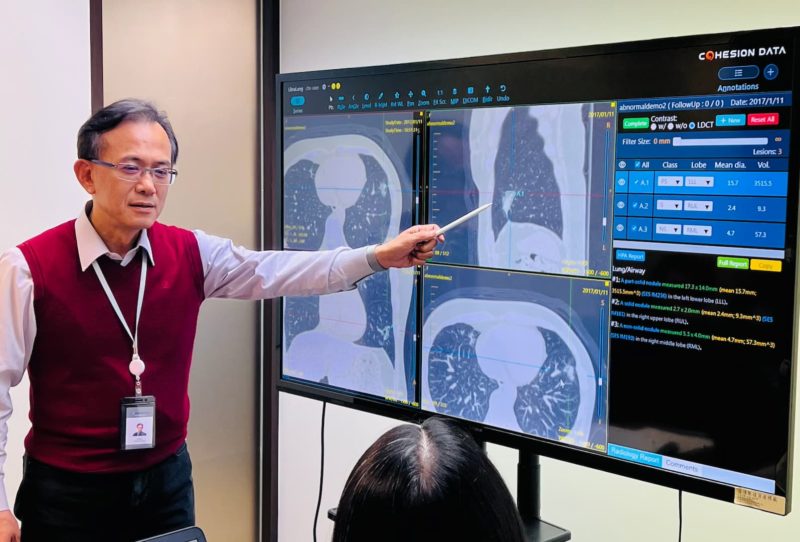
Low-dose computed tomography (LDCT) has been internationally proven as the most effective tool for detecting early-stage lung cancer. Cohesion Data has developed the LibraLung AI-assisted system to interpret LDCT images. Validation studies show that LibraLung can save an average of 29% of radiologist reading time and detect 25% more lung nodules that would otherwise be missed by the naked eye. The system delivers a 92% overall detection accuracy with an average false positive rate of 0.6 per scan.
▲William Huang, General Manager of Cohesion Data, noted that LibraLung significantly improves lung nodule detection when assisting LDCT interpretation. (Photo Credit: Cohesion Data)
Lung cancer is the leading cause of cancer mortality in both Taiwan and worldwide. Its low survival rate is closely tied to the fact that most cases are diagnosed at late stages. However, if detected at stage 1 and treated promptly, the five-year survival rate can exceed 90%. In 2022, Taiwan Health Promotion Administration launched an early lung cancer detection program. Over two and a half years, the program achieved a 1.2% lung cancer detection rate, with 83.2% of identified cases in stages 0–1, demonstrating its effectiveness in finding early-stage lung cancer. Taiwan is the first country to offer LDCT screening for individuals with a family history of lung cancer or heavy smoking history. Since implementation, 160,000 people have undergone screening, and the government has set a target of 750,000 people to be screened in 2025.
Yet LDCT generates hundreds of images per scan. Radiologists must visually examine each slice to identify millimeter-sized nodules and classify findings according to Lung-RADS v2022 standards. The nationwide screening policy once faced challenges due to the heavy workload placed on radiologists.
Combining Medical Center and Local Data for AI Model Training
Since 2018, Cohesion Data has collaborated with National Taiwan University Hospital to develop LibraLung under the supervision of the Health Promotion Administration. The AI model was trained using over 1,700 imaging datasets annotated by more than 15 clinicians, with a focus on identifying nodules smaller than 4mm. The model was further validated in partnership with Wanfang Hospital, Tri-Service General Hospital, and other leading medical centers, achieving 92% overall detection accuracy, a 0.6 false positive rate, 91% classification accuracy, 88% sensitivity, and 99% accuracy and sensitivity in lobe localization. The system increased nodule detection by 25% and improved interpretation consistency by 31%, enhancing early diagnosis outcomes.
In a large-scale clinical trial of 1,000 patients, LibraLung helped physicians increase interception rates of severe category 4 cases up to 226.7%. According to Dr. Yeun-Chung Chang, Director of the Cardiothoracic Imaging Division at National Taiwan University Hospital, implementing AI reduced per-case reading time from 10–15 minutes to under 5 minutes—improving efficiency nearly threefold.
In 2024, LibraLung officially received Taiwan FDA Class II medical device certification. Its interpretation workflows and reporting are fully aligned with the Lung-RADS v2022 standard promoted by the Health Promotion Administration. General Manager William Huang emphasized that LibraLung’s development and maintenance adhere to ISO 27001/27701 international information security standards. The company has also established a rigorous Predetermined Change Control Plan (PCCP) to ensure continuous, safe, and effective AI model updates. “When healthcare institutions adopt LibraLung, they’re not just acquiring a tool—they’re implementing a government-compliant, mature smart healthcare governance framework,” Huang said.
Data Services Spanning Occupational Health and Primary Care
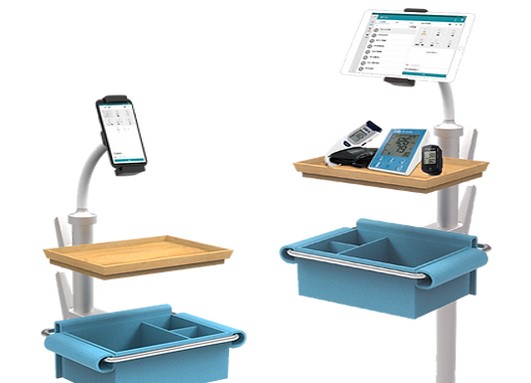
Another core product from Cohesion Data is the HealthBee digital health platform, designed for corporate employee health management. HealthBee integrates health screening records, personal health records, and daily physiological measurements, enabling enterprises to assess health risks, stratify management, and implement personalized health promotion plans efficiently. Over 200,000 employees across Taiwan are currently covered this service.
Additionally, Cohesion Data powers the cloud-based electronic medical record systems used by 80% of Taiwan’s primary care clinics, as well as the AI application platform of the National Health Insurance Administration. The company’s data governance and cybersecurity specifications comply with national standards. From nationwide health management to precision diagnostics, Cohesion Data has accumulated deep experience and demonstrates strong ambition within the smart healthcare ecosystem.